Meyers Nave Names Jenny L. Riggs Chair of Trial and Litigation Practice Group

Meyers Nave announces that Jenny L. Riggs has been named Chair of its statewide Trial and Litigation practice group. In this role, Jenny will guide strategy, strengthen client service, and lead the firm’s complex litigation practice in California.

Jenny brings deep courtroom experience in state and federal courts —Jenny has played a central role in shaping litigation strategy for clients in complex, document-intensive, and sensitive matters, and her experience in crisis management litigation informs her client-centered approach.

Jenny represents clients in matters involving government corruption, disaster litigation, land use, inverse condemnation, and civil rights. Known for rigorous preparation and clear advocacy, Jenny leads cases from early strategy through trial and appeal for private entities, non-profit organizations and government entities including cities, counties and special districts.

Jenny is also deeply involved in mentoring and developing the next generation of trial lawyers.

Jenny is licensed to practice in California and Hawaii and is admitted to all California and Hawaii state courts, the United States District Courts in California and Hawaii, and the United States Court of Appeals for the Ninth Circuit. She has been recognized by The Best Lawyers in America for Commercial Litigation.
Court Affirms City of Carlsbad’s Right to Shape Housing Growth Over Time

On December 18, 2025, Meyers Nave won an important growth management appeal for the City of Carlsbad that affirms the City has been correctly implementing its Growth Management Program for the last 40 years. This decision affirms our team’s original lower court win.

North County Advocates (NCA), and its members, have repeatedly sued the City for alleged violations of the Growth Management Plan for more than a decade.  This included challenges to specific development projects and a challenge to the city-wide General Plan amendment in 2017. The current case began in 2019 when NCA again alleged Carlsbad was allowing development in violation of the city’s growth management standards and Proposition E passed by voters in 1986. However, Proposition E only set the broad goal of “ensuring good traffic circulation, schools, parks, libraries, open space and recreational amenities.” The City’s specific performance standards were previously adopted by City Council, and amended numerous times over the previous decades.

The Court of Appeal unanimously confirmed that (1) existing laws referenced in a ballot measure do not become part of the text of the ballot measure, and can still be amended, and (2) the City’s regulations expressly gave the City Council the authority to amend these standards. Indeed, the Court of Appeal confirmed that NCA had conceded this point; noting “by Agreeing to the 2017 Settlement that required the City to amend the parks performance standard, NCA recognized that continuing amendment authority.”

The Court of Appeal also confirmed that the City is properly implementing its performance standards for parks, open space, and traffic, concluding that (1) the new 91.5 acre Veteran park will benefit all four quadrants of the City, (2) the City had the ability to exempt specific roadways from being widened, (3) the City had properly exempted built out zones from the open space standard in 1986, and (4) the City has been monitoring and reporting open space “in the manner agreed upon in the 2017 [NCA] Settlement.”

Development and governing in California is complex. Meyers Nave is proud to defend the City of Carlsbad and the interests of other government entities, businesses, developers, and nonprofits across the state.

To read the Court of Appeal’s decision, click here.

2026 Employment Law Update

Stay Ahead of 2026’s Legal Changes.

Our Labor & Employment Team has you covered with our 2026 Meyers Nave Employment Law Update handout detailing new and evolving laws for Government Entity, Private Sector, and Non-Profit California Employers.

This valuable resource covers the following:

  • Navigating the New Frontiers of App-Based Labor
  • State and Local Ordinance-Based Minimum Wages To Be Increased
  • Pay Equity Enforcement Act Expanded to Require More Information and the Potential for More Liability for Violations
  • Employment Contract Repayment Provisions (AB 692) Now Prohibited
  • Paid Family Leave Benefits to Care for “Designated Persons” Will Start in 2028
  • Judicial Proceeding and Jury Duty Leaves (AB 406) Clarified By New Law
  • Workplace Know Your Rights Act (SB 294) Addresses Immigration and Workers Comp Concerns
  • AI Transparency Law for Frontier Models (SB 53) Require Employer Action
  • Personnel Records (SB 513) Must Include Training Documents
  • Bias Mitigation Training (SB 303) Encouraged, But Not Required
  • PERB Jurisdiction Expanded for Labor Disputes in the Private Sector
  • Cal-WARN Notice (SB 617) Require Updating to Include Info on Public Benefits
  • Unsatisfied Wage Judgments (SB 261) to Meet Stiffer Enforcement Efforts
  • Penalties for Pay Data Reporting Failures (SB 464) Now Mandatory
  • Extended Statute of Limitations for Sexual Assault / Harassment Claims (AB 250) in Cases of a “Cover up”

Download the 2026 Meyers Nave Employment Law Update Now

WOTUS Overhaul: Clean Water, New Rules

The EPA and the US Army Corps released a proposed new definition of “Waters of the United States” (WOTUS) on November 17, 2025, marking yet another major shift in how federal jurisdiction is asserted under the Clean Water Act. Once a strict framework for protecting wetlands and streams, the proposed definition now aims to balance water protection with accelerated growth and economic opportunity. This change responds directly to the Supreme Court’s Sackett v EPA decision.

Key takeaways from the proposed definition:

Revisions to key definitions:

  • “Relatively permanent waters”: only includes bodies of surface water that are standing and continuously flowing “year-round or at least during the wet season”, e.g., lakes or rivers
  • “Continuous surface connection” for wetlands: wetlands must physically touch a regulated water body to qualify
  • “Tributaries”: must connect to navigable water body, directly or through other connected features

New and clarified exclusions proposed:

  • Intrastate lakes or ponds or interstate waters unless otherwise jurisdictional (per above)
  • Groundwater
  • Waste treatment systems
  • “Prior converted” farmland and certain ditches

Why this matters: 

  • Landowners, agriculture, and businesses: Greater predictability and fewer permitting hurdles
  • States and Tribes: Enhanced authority to shape local water regulations
  • Environmental Advocates: Concern that protections—especially for wetlands lacking clear connections—are weakened

Next steps: 

The proposed new definition is now open for public comment, and the EPA will hold public meetings to gather input. For support in reviewing the proposal or preparing and submitting a comment, please contact Meyers Nave. Stay tuned for how this rule ultimately lands.

Meyers Nave recognized in the 2026 edition of Best Law Firms by U.S. News – Best Lawyers

Best Lawyers® and U.S. News & World Report have released their 2026 U.S. News – Best Lawyers® “Best Law Firms” rankings.

Among them, Meyers Nave was ranked in seven categories, including National Tier 3 for Land Use and Zoning Law and seven other regional positions.

We are proud to be ranked in all of the following categories — a result of the top notch work performed every day by our attorneys for our valued clients.

National Tier 3: Land Use and Zoning Law

Regional Tier 1

  • Oakland: Natural Resources Law
  • San Diego: Litigation – Labor and Employment

Regional Tier 2

  • Los Angeles: Land Use and Zoning Law
  • Oakland: Environmental Law
  • San Diego: Employment Law – Management

Regional Tier 3

  • Los Angeles: Litigation – Land Use and Zoning Law
  • Sacramento: Municipal Law

Firms included in the 2026 edition of US News – Best Lawyers® “Best Law Firms” are recognized for professional excellence with consistently impressive ratings from clients and peers.

To be eligible, a firm must first have a lawyer recognized in The Best Lawyers in America®, which honors 6% of lawyers practicing in the United States. Nine of our attorneys were recognized in 2026 as “Best Lawyers” and three were heralded as “Best Lawyers: Ones to Watch in America” in their respected fields.

The Best Law Firms list is determined by client and lawyer evaluations, peer reviews from leading attorneys in the field and review of additional information provided by law firms. According to Best Lawyers, “Achieving a tiered ranking in U.S. News – Best Lawyers® “Best Law Firms” signals a unique combination of quality law practice and breadth of legal expertise.”

Internal Investigations: Getting to the Bottom of Things without Getting Bogged Down

Something is Brewing: It isn’t even noon and you have already received an anonymous complaint that a person in shipping was offended by a delivery person’s suggestive comment. Then when you grabbed some coffee, you overheard a conversation that an executive made a “bullying comment” to another executive in a meeting, “just like she always does.”

Something Needs to Happen: You know these situations need to be addressed but do they require an investigation? Yes, in California, employers have a duty to investigate harassment, discrimination, and retaliation when they become aware of such concerns. In fact, courts have held that an employer’s failure to investigate these types of complaints can create a separate cause of action for a failure to investigate, and an employer’s failure to take immediate and effective action can be taken as the employer’s ratification of the harassment. Little v. Windermere Relocation, Inc. (9th Cir. 2002) 301 F3d 958, 968. Employers should also conduct investigations when they become aware of work threats of violence, fraud, waste or abuse, and other misconduct.

So, What Now? This means that you need to:

  • determine what issues need to be investigated and the relevant policies;
  • understand who is the most appropriate person to look into these concerns;
  • establish appropriate follow-up steps; and
  • document the investigation steps and findings.

Whether you need guidance on how to conduct an internal investigation or you need someone to come in and conduct the investigation for you, the Meyers Nave team can help.

Connect with one of our labor and employment attorneys and let us set you up for success.

Our team is here to help you navigate California’s complex employment laws. If you have investigation questions, contact us.

Why Mediate?

Picture this: The mail arrives one day, and in it you find what every employer dreads—a demand letter. One of your former employees has retained an attorney, is claiming they were wrongfully terminated, and is now threatening to take legal action. The demand letter outlines all sorts of crazy false allegations, demands an insane amount of money, and your first instinct is to call the employee’s bluff and put the letter through the shredder.

Wait! You may never have this opportunity again. This is your chance to find out more information about the allegations, to evaluate the claimant and their counsel, to test your side of the facts, and to possibly resolve the matter for the lowest possible figure before fees and costs rise exponentially. In short, you have a chance to mediate the dispute.

What is mediation? Mediation is a private service, conducted by a neutral and experienced third party, aimed at resolving a conflict prior to initiating legal action. Mediators do not make any binding decisions about the matter; their role is to facilitate communication and help move the parties from opposite ends to a place of compromise and agreement.

While the primary goal of mediation is often the full resolution of the conflict, there are many other benefits to mediation that make it worthwhile even if settlement is not reached. These benefits include:

  • A preview of the claimant and their allegations;
  • An opportunity to confidentially test drive your client and your facts without the pressure of the court process;
  • A neutral and experienced third party’s fresh perspective and insight into the strengths and weaknesses of the different sides;
  • Honest feedback for your client about potential weaknesses in your client’s position;
  • Tools to facilitate settlement, such as a mediator’s proposal, or a high/low agreement; and
  • Pre-litigation mediation often results in a lower settlement figure because attorneys’ fees have not yet accumulated.

Even if a case does not settle, mediation is rarely a waste of time or resources. Let Meyers Nave help you navigate mediation as an important tool in your compliance toolbox.

Connect with one of our labor and employment attorneys and let us set you up for success.

Our team is here to help you navigate California’s complex employment laws. If you have handbook questions or don’t have a handbook at all, contact us.

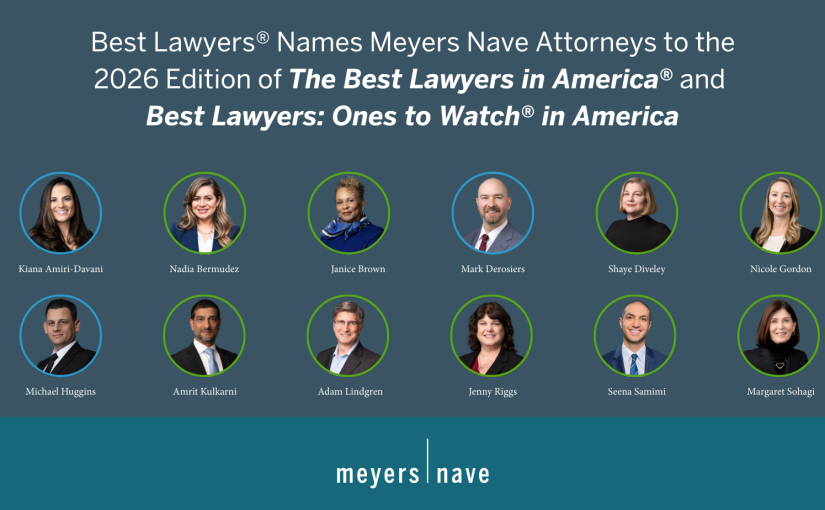
Best Lawyers® Names Meyers Nave Attorneys to the 2026 Edition of The Best Lawyers in America® and Best Lawyers: Ones to Watch® in America

We are proud to announce that 11 Meyers Nave attorneys have been recognized in the 2026 Edition of The Best Lawyers in America® and Best Lawyers: Ones to Watch in America™. This honor reflects their unwavering commitment to serving our clients, leadership in the legal profession, and dedication to serving our clients and communities.

The Best Lawyers in America (2026 Edition)

Los Angeles, CA

Oakland, CA

Sacramento, CA

San Diego, CA

  • Nadia Bermudez – Employment Law – Management; Litigation – Labor and Employment
  • Janice P. Brown – Employment Law – Management; Litigation – Labor and Employment

Best Lawyers: Ones to Watch in America (2026 Edition)

Los Angeles, CA

We congratulate each of these exceptional attorneys for their well-deserved recognition and thank them for their dedication to advancing excellence in law and delivering outstanding results for our clients.

Meyers Nave Wins on Summary Judgment for MTS in Figueroa v. Fletcher

We are proud to announce that Meyers Nave successfully obtained summary judgment on behalf of our client, the San Diego Metropolitan Transit System (MTS), in the widely publicized lawsuit Figueroa v. Fletcher.

The court granted summary judgment on all claims against MTS, including allegations of sexual harassment, discrimination, and retaliation.

We extend our sincere thanks to MTS for placing their trust in Meyers Nave to handle such an important and challenging matter. Congratulations to lead counsel, Nadia Bermudez and Janice Brown, in addition to their entire team, whose expertise, dedication, and tireless effort made this outcome possible.

The magnitude of this result reflects our strategic approach in defending harassment cases.

Defending Affordable Housing in Santa Monica

We are proud to announce another legal victory on behalf of the City of Santa Monica with the Hollywood Community Housing Corporation in their efforts to bring critically needed affordable housing to our communities.

Tyson Sohagi and our Land Use & Environmental team successfully prevailed in two separate lawsuits challenging the City’s approval of a 100% affordable housing development project at 1217 Euclid Street. The Los Angeles Superior Court granted the City’s motions to strike both complaints under CCP § 425.19, a new statute designed to protect affordable housing projects from litigation and award defendants their attorney’s fees. (La Brea Washington Co. LLC v. City of Santa Monica, LA Superior Court Case Nos. 25STCP00154 and 25STCP00961.)

These rulings reaffirm that cities have the authority, and duty to prioritize housing solutions for lower-income residents without being hindered by unnecessary legal roadblocks. The project will replace an underutilized City-owned parking lot with 48 affordable homes, furthering the City’s commitment under its Housing Element to address the housing crisis with bold, forward-thinking policy.

We are honored to represent our client in this effort and are proud of the positive results we’ve helped achieve – not only for our clients, but for the broader community and future residents of Santa Monica.