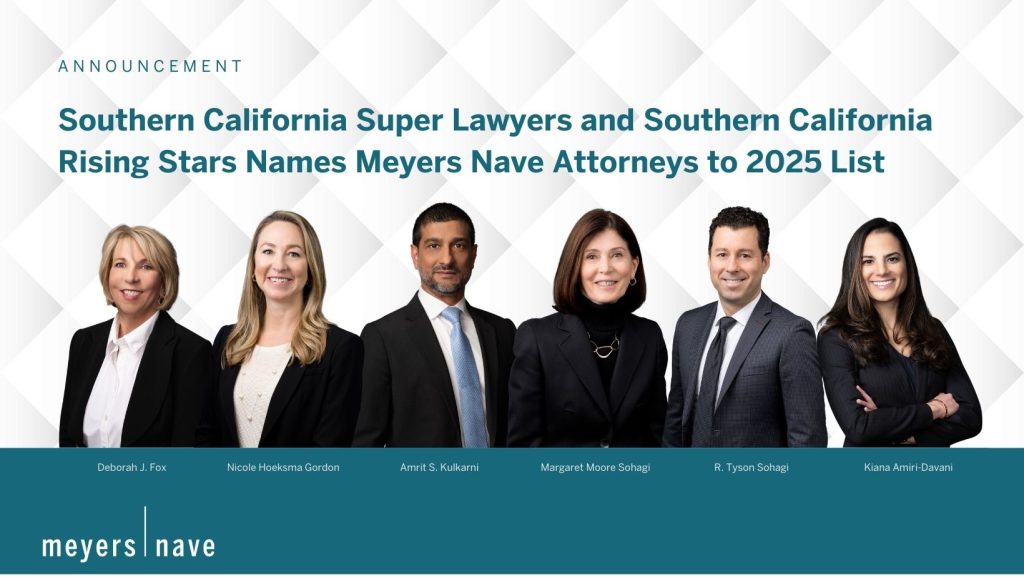
Southern California Super Lawyers and Southern California Rising Stars Names Meyers Nave Attorneys to 2025 List

Congratulations to our exceptional team of attorneys at Meyers Nave who have been named to the 2025 Southern California Super Lawyers and Southern California Rising Stars lists!

The Meyers Nave lawyers ranked include:

Only up to five percent of the lawyers in California are named to the Super Lawyers list. Super Lawyers is a rating service of outstanding lawyers from more than 70 practice areas who have attained a high degree of peer recognition and professional achievement. The selection process includes independent research, peer nominations and peer evaluations.

We are proud to have these talented attorneys on our team, delivering top-tier legal counsel to our clients.

Three Sohagi Law Group Attorneys Named “Best Lawyers in America”

LOS ANGELES – August 19, 2024 – Environmental and land use law firm The Sohagi Law Group announced today that Best Lawyers in America has recognized Managing Partner Margaret Sohagi and Partner Nicole Hoeksma Gordon in the 31st edition of The Best Lawyers in America, and Associate Mark Desrosiers in the fifth edition of Best Lawyers: Ones to Watch® in America. The rigorous selection process of Best Lawyers awards “ensures that the 79,116 honorees in The Best Lawyers in America and the 26,916 recognized in Best Lawyers: Ones to Watch in America are leaders in their fields” and “are respected by their colleagues, showcasing them as the most distinguished members of the legal community.”

“As an industry-driven professional recognition, it is the opinion of lawyers themselves that determines our awards,” states the periodical. “We received record-breaking voter participation in this year’s editions. With more engagement from the market, the barrier for recognition is higher and more competitive than ever before. This reflects not only the profession’s commitment to celebrating professional excellence, but also the increasing importance of every voice in shaping the standards of legal distinction.”

For more information, please read the full press release HERE.

Two Sohagi Law Group Partners – Now Meyers Nave Principals – Named Top Litigators in America

LOS ANGELES, CA, September 11, 2024 /EINPresswire.com/ — Nicole Hoeksma Gordon and R. Tyson Sohagi have been recognized by Lawdragon in its “2025’s 500 Leading Litigators in America.” The publication received a record number of submissions and based their selections on original journalistic research and an extensive vetting process.

“These lawyers [on the list] win hundreds of millions, billions even,” states the publisher. “They win rights, or lose them. They win freedom, or lose it for someone. They have the abilities to change businesses and entire industries. It’s an audacious thing a trial lawyer does: to tell a judge, jury or other arbiter, ‘Hear me. Believe me. Rule for my client.’ Bravo to everyone here, and every litigator out there working on their craft and a cause.”

For more information, please read the full press release HERE.

The Sohagi Law Group – Now a part of Meyers Nave – Named “Best Law Firm” By Best Lawyers Firm Secures “Tier 1” Band Recognition

LOS ANGELES – November 13, 2024The Sohagi Law Group , now a part of Meyers Nave announced that it has been recognized by Best Lawyers® Best Law Firms® 2025 among the nation’s elite law firms.

“Over the past decade, these awards have cemented their place as one of the most respected, utilized and comprehensive guides to legal excellence, serving as a trusted resource for both clients and legal professionals seeking distinguished representation in a diverse array of practice areas,” states the publisher. “This edition features firms that have not only achieved the highest standards of legal expertise but also have a proven track record of success across a range of complex and dynamic legal issues.”

The Sohagi Law Group’s practice focuses on assisting cities, counties, and other public agencies navigate the legal complexities of land use and California Environmental Quality Act (CEQA), including infrastructure and green energy, climate change and housing supply. When necessary, it zealously defends lead agencies’ land use approvals and environmental determinations in judicial proceedings, and frequently heads mediation teams in settlement discussions.

For 2025, The Sohagi Law Group has been nationally ranked “Tier 1” in land use and zoning law.

Los Angeles Business Journal Names Amrit Kulkarni to 2025 List of Leaders of Influence: Minority Attorneys

The Los Angeles Business Journal has named Amrit Kulkarni, the Chair of the firm’s Land Use, Environmental Law, and Transportation and Infrastructure practice groups, to its 2025 list of “Leaders of Influence: Minority Attorneys.” The feature profiles “minority attorneys considered to be particularly impactful on the legal scene while serving as trusted advisors in the LA region.”

Amrit was noted as a standout leader with the “ability to navigate complex regulatory frameworks such as CEQA, NEPA and zoning laws, while balancing environmental, legal and business priorities.”

The LABJ highlighted that Amrit has been instrumental in the success of transformational infrastructure and urban development projects across California. His most recent work includes the ocV!be, DisneyLandForward and continued work for the Los Angeles World Airports and BNSF Railway. He advised on the Oakland A’s Howard Terminal Ballpark, LA Metro’s rail expansion, and the modernization of LAX.

Learn more about Amrit and his practice.

View the LABJ’s 2025 List of Leaders of Influence: Minority Attorneys.

How Rescheduling Cannabis and Trump’s Election Impacts Cannabis in California

The cannabis industry in California has always operated in an area of legal uncertainty. Although California was the first state to legalize medical marijuana, cannabis has always remained federally illegal as a Schedule 1 drug under the Controlled Substances Act. This has led to a situation where for over more than two decades, canna-businesses operating in California have been operating under the cloud of federal illegality. This impacts the ability of canna-businesses to operate freely, due to banking restrictions, the uncertainty of regulations, and the risk of federal enforcement.

The DEA is currently in the process of rescheduling cannabis to Schedule 3 from Schedule 1 under the Controlled Substances Act. The DEA will hold a hearing on December 2, 2024 on the attorney general’s proposal to loosen restrictions on marijuana. The hearing comes after the period for public comment on the Biden administration’s proposal to reclassify marijuana came to a close, soliciting over 40,000 comments from an array of stakeholders.

The rescheduling of cannabis would impact the regulatory landscape in California, but not as drastically as some would think. Foreseeable changes include:

  1. Easing banking and financial limitations for cannabis businesses
  2. Allowing more research to be conducted relating to medical uses
  3. Standardized regulatory framework, aligning state and federal laws, which may encourage investment and innovation within the cannabis industry

The last Trump administration had a generally hands-off approach towards cannabis regulation, particularly in states that had legalized it. Initially, Attorney General Jeff Sessions took a hardline stance against cannabis, expressed a desire to enforce federal cannabis laws more strictly, and rescinded the Cole Memo, which had provided guidance to states on legal cannabis. Sessions’ tenure was short, however, and as the administration progressed, there was a more lenient approach, particularly concerning states that had legalized cannabis. The Trump administration did not introduce significant federal legislation to change cannabis regulations, leaving much of the regulatory landscape to the states.

The likely outcome with a new Trump administration is that states would still retain the authority to regulate cannabis as they see fit, meaning California could continue to enforce its own regulations while benefiting from the reduced federal constraints. This means that cannabis operators would still need to undergo the same procedures that are in place now. Namely, 1) obtaining local approvals from your local jurisdiction, and 2) obtaining state approvals.

The cannabis industry in California will continue to grow, and with it, will disputes arising out of cannabis businesses. These include everything from fights with localities regarding permitting/entitlement issues, to business disputes among partners in the cannabis space, to clashes among neighboring property owners regarding land use and real property issues. When such disputes arise, our team is here to help you navigate and assess how they may affect your business. For more questions or for more information, please contact us.

Meyers Nave Achieves Major Appellate Victory for Water Districts in Groundwater Management Case

We are pleased to announce a significant appellate victory for our clients, Mesa Water District, East Orange County Water District, and Yorba Linda Water District, in the case of Irvine Ranch Water District v. Orange County Water District. The California Court of Appeal’s decision upholds critical groundwater management practices that protect local ratepayers and ensure fair access to water resources.

Background of the Dispute

The litigation began in 2016 when Irvine Ranch Water District (IRWD) challenged the Orange County Water District’s (OCWD) management of the Orange County Groundwater Basin. IRWD sought to reclassify its recycled water, which would have allowed it to pump more groundwater at reduced costs, while shifting millions in expenses to other water suppliers. IRWD also aimed to secure approval for exporting water outside of OCWD’s jurisdiction, a move that threatened the reliability of the water supply serving 2.5 million residents in northern and central Orange County.

Meyers Nave was retained by Mesa Water District, East Orange County Water District, and Yorba Linda Water District to defend against IRWD’s claims and safeguard their interests. Working alongside the City of Anaheim and Golden State Water Company, we coordinated a common interest group that opposed IRWD’s efforts.

Appellate Court Decision

The Court of Appeal’s ruling is a pivotal win for our clients, affirming OCWD’s established groundwater management practices and prevailing on 15 out of 16 claims. The lone unfavorable ruling was effectively nullified by other decisions in our clients’ favor. The appellate court’s decision ensures fair groundwater access and rate stability for local communities, preventing the cost shifts IRWD sought to impose.

Acknowledgments

We are proud of the exceptional teamwork demonstrated by Meyers Nave throughout this litigation. With critical contributions from Kiana Amiri-Davani our team played a key role in this significant win for our clients. This result reflects our dedication to achieving favorable outcomes for our clients and protecting vital public resources.

We remain committed to delivering outstanding legal representation and are honored to have played a role in preserving fair water management practices that benefit millions of Orange County residents.

For more details on the case and its outcomes, visit the Orange County Water District’s official announcement here.

AB 98 Enacts Statewide Standards for Logistics Use Warehouses

On September 29, Governor Newsom signed Assembly Bill 98, a bill establishing warehouse design and build standards for new or expanded “logistics uses”, requiring cities and counties to update their circulation elements to include truck routes, and imposing air pollution study requirements on the South Coast Air Quality Management District. Commencing January 1, 2026, AB 98’s regulations preempt local regulation of warehouses serving logistics uses. Cities and counties cannot approve logistics use developments that do not meet the minimum standards in AB 98.

Logistics Use Facility Development Requirements:

AB 98 regulates new or expanded (by over 20% of existing square footage) logistics uses. A “logistics use” is specifically defined as “a building in which cargo, goods, or products are moved or stored for later distribution to business or retail customers, or both, that does not predominantly serve retail customers for onsite purchases, and heavy-duty trucks are primarily involved in the movement of the cargo, goods, or products.” The statue creates a complicated set of regulations that apply depending on whether or not the logistics use meets certain standards.  The purpose of the regulations is to address the effects of emissions from heavy duty trucks serving logistics use warehouses on sensitive uses.

AB 98 applies different development standards to logistics use facilities based on various factors including: (1) whether a facility’s size exceeds 250,000 square feet; (2) whether loading bays (i.e., dock doors) are less than 900 feet from a sensitive receptor (including residences, schools, daycare facilities, parks, nursing homes and hospitals); (3) whether the site’s existing zoning is industrial or non-industrial; (4) whether the site is located in a “warehouse concentration region”; and (5) the entitlement application date for the new or expanded facility.

The standards which apply to warehouse building and site plan design include the following: building design and location, parking, truck loading bays, landscaping buffers, entry gates, and signage. Generally, stricter standards apply to larger logistics uses abutting sensitive receptors in areas zoned for non-industrial uses (“Non-Industrial Areas”). For example, logistics facilities in Non-Industrial Areas must provide a 500-foot setback from the loading bay to the property line of sensitive receptors; whereas, the same facilities in areas zoned for industrial uses (“Industrial Areas”) must provide a 300-foot setback. Less strict standards apply to smaller logistics uses (less than 250,000 square feet) in Industrial Areas, which do not need to meet the 300-foot setback requirement. Similarly, landscaped walls, berms or buffers required to screen adjacent sensitive uses from logistics uses must be 50-feet in Industrial Areas, and 100-feet in Non-Industrial Areas. Additionally, logistics uses requiring demolition of housing units occupied in the last 10 years must replace each such unit with two units of moderate- or low-income housing and provide displaced tenants with payments equal to 12 months’ rent at the current rate.

The stricter “tier” of “21st century warehouse design standards” under AB 98 (“Tier 1”) applies exclusively to larger logistics use facilities (greater than 250,000 square feet), regardless of whether in Industrial or Non-Industrial Areas. The “Base” tier applies to smaller facilities (less than 250,000 square feet) in Non-Industrial Areas, while neither tier applies to smaller facilities in Industrial Areas. Moreover, any logistics use in a Non-Industrial Area in the warehouse concentration region (the Counties of Riverside and San Bernardino and the Cities of Chino, Colton, Fontana, Jurupa Valley, Moreno Valley, Ontario, Perris, Rancho Cucamonga, Redlands, Rialto, Riverside, and San Bernardino) must orient truck bays on the opposite side from sensitive receptors, to the extent feasible; locate truck entry, exit, and internal circulation away from sensitive receptors; provide buffering and screening from light and noise; and have separate entrances for heavy-duty trucks.

Local Agency Land Use Planning Requirements:

AB 98 also requires local governments to update the circulation element components of their General Plans to ensure truck routes avoid residential areas, to the extent feasible. Circulation elements must:

  1. Establish specific travel routes for truck traffic that can accommodate additional traffic and avoid residential areas and sensitive receptors; and
  2. Maximize highway use as preferred routes, followed by major thoroughfares and predominately commercially oriented local streets when strictly necessary to reach existing industrial zones.

Logistics uses proposed after January 1, 2028 must be accessible by arterial roads, major thoroughfares, or roads that predominantly serve commercially oriented uses. Truck routes, parking, and idling facility locations must be marked by conspicuous signage, and routes must be made publicly available in geographic information system (GIS) format.

Circulation elements must be updated by January 1, 2028 for cities and counties located outside of the warehouse concentration region.  Those in the warehouse concentration region are subject to an accelerated timeline and must update their circulation elements by January 1, 2026. The Attorney General is authorized to penalize noncompliant agencies with a penalty of up to $50,000 every six months until the required updates are made.

South Coast AQMD Requirements:

AB 98 requires South Coast AQMD to submit reports to the legislature in 2028 and 2033 regarding air pollutant concentrations at various distances from logistics use facilities in Riverside and San Bernardino County communities near logistics use developments. These reports are meant to assess the effectiveness of the proscribed setbacks and buffers in AB 98.

South Coast AQMD must also establish a process for receiving community input on assessing and collecting penalties from violators of the Warehouse Indirect Source Rule, and how these penalties should be spent. Community groups must contain representation from areas with high numbers of warehouse facilities.

Takeaway:

AB 98 is the first State legislation to establish regulations to address the impact of logistics uses warehouses on sensitive receptors.  The regulatory regime is complicated and will establish minimum standards to replace the patchwork of local regulations throughout the State.

Deborah Fox Named Among the Daily Journal’s Top 100 Lawyers in California for 2024

Meyers Nave is proud to announce that Deborah Fox, Chair of our First Amendment and Trial & Litigation Practice Groups, has been recognized as one of the Daily Journal’s Top 100 Lawyers in California for 2024. This marks the fourth time Deborah has received this prestigious honor since 2020.

Deborah’s consistent inclusion in this elite list highlights her unwavering commitment to excellence in legal practice and her leadership in guiding clients through complex and high-profile cases. Her work in First Amendment law, Crisis Management, Litigation, and her success in the courtroom underscore her remarkable impact on the legal landscape in California.

At Meyers Nave, we are honored to have Deborah as a key member of our team. Her achievements align with our firm’s mission to provide outstanding legal service and deliver results that matter. We congratulate Deborah on this significant accomplishment and look forward to her continued contributions to the legal community.

For more information about Deborah Fox’s work and her role at Meyers Nave, visit her bio.

Deborah Fox recognized as one of the Top Women Lawyers by the Daily Journal

We are excited to announce that Deborah Fox has once again been recognized as one of the Top Women Lawyers by the Daily Journal. This prestigious award highlights Deborah’s exceptional legal acumen and continued commitment to excellence. We are beyond proud to have such a remarkable attorney and person on our team.

Deborah’s contributions not only elevate our firm but inspire future generations of women in law. Congratulations, Deborah, on this well-deserved honor!