CEQA LexisNexis® Practical Guidance Practice Note

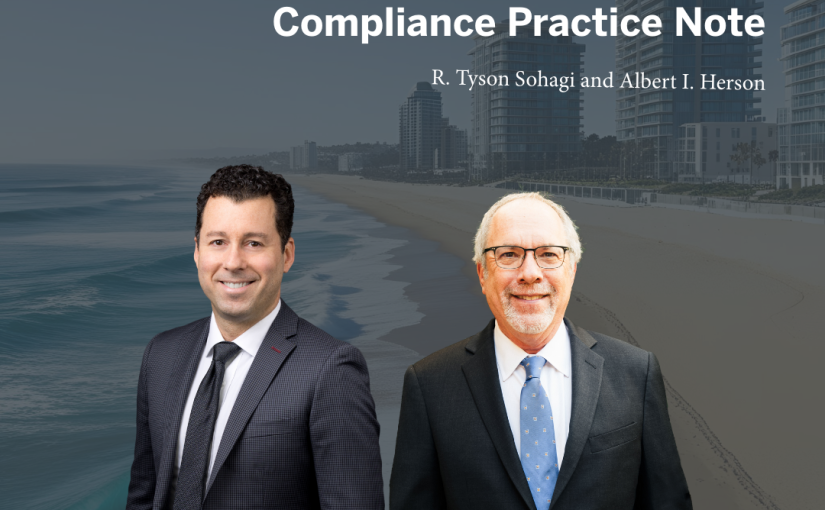
R. Tyson Sohagi and Albert I. Herson from Meyers Nave are proud to again author the LexisNexis® Practical Guidance practice note on California’s broadest environmental law, the California Environmental Quality Act (CEQA).

CEQA mandates state and local agencies to evaluate, disclose, and mitigate environmental effects of discretionary projects before taking action. CEQA does not establish regulatory standards but informs decision-makers and the public about significant environmental effects and feasible mitigation measures. Also discussed are CEQA requirements, established by the California Public Resources Code and the CEQA Guidelines in Title 14 of the California Code of Regulations. These requirements are the official administrative interpretation of CEQA and are heavily relied upon by agencies and courts.

Key sections include:

  • Sources of CEQA Requirements, including statutes and relevant case law
  • Players in the CEQA Process
  • Overview and Timing of the CEQA Process
  • Practical Considerations
  • Preparation and contents of the Environmental Impact Report (EIR)
  • Integrating CEQA with Other Environmental Laws, such as NEPA, the Endangered Species Act (Federal and California), Section 404 of the Clean Water Act, the California Coastal Act, the Seismic Hazards Mapping Act, and the State Aeronautics Act, among others.
  • Judicial Review, including standards of review, time limits for challenges, and streamlined judicial processes for certain projects

Clients and other interested parties can request a pdf via email at: marketingdept@meyersnave.com or LexisNexis® account holders can view a summary and download here.

Meyers Nave Ranked in Chambers Spotlight California 2025 Guide

We’re honored to announce that Meyers Nave has earned a ranking in the inaugural Chambers Spotlight California 2025 Guide, which highlights standout small and mid-sized firms across the state. Our firm was recognized for its work in Real Estate and Environment (Oakland) —two of our Land Use and Environmental practice areas where our team of attorneys have consistently delivered outstanding results for clients.

This recognition is the result of Chambers’ in-depth, independent research and reflects the experience, talent, and commitment of our attorneys to providing excellent legal counsel and practical solutions. It also reinforces our longstanding focus on California’s unique legal and regulatory landscape—one we know well and serve every day.

Chambers Spotlight is a new initiative aimed at connecting General Counsel and business decision-makers with high-performing, regionally focused firms. With over 18 million visits to Chambers.com in 2024 and 65% of Spotlight users working outside of legal services, this recognition enhances our visibility among a broader audience of corporate and government sector leaders.

We appreciate Chambers for this distinction and congratulate all of our Land Use & Environmental attorneys and staff for their continued hard work and success.

For more information, visit Chambers.com.

Court of Appeal Invalidates County’s Vehicle Miles Traveled (VMT) Screening Thresholds for CEQA Review

A California court of appeal has held that a lead agency conducting environmental review, under the California Environmental Quality Act (CEQA), of “vehicle miles traveled” (VMT) impacts may not unquestioningly use thresholds for determining impact significance that borrowed from the recommendations of other agencies.

Notably, the court rejected San Diego County’s reliance on thresholds recommended by the state Office of Planning and Research (OPR), which promulgated the CEQA Guidelines provisions governing transportation impact analysis (i.e., Guidelines section 15064.3), and also prepared a Technical Advisory for agencies implementing CEQA’s VMT requirements.

Rather, the court held, each lead agency must determine, based on fact-based substantial evidence, that the VMT significance thresholds it elects to use – regardless of their origin – are suited to the purpose of identifying significant VMT impacts in the particular circumstances.

The case, Cleveland National Forest Foundation v. County of San Diego (2025), concerns a challenge to the County’s adoption of two thresholds for “screening” for general use (i.e., determining without further analysis) that certain types of projects will result in less-than-significant VMT impacts.  The Petitioner challenged two such screening thresholds, namely the thresholds for: (1) “infill” projects proposed within the County’s unincorporated villages (the “Infill” threshold), and (2) projects expected to generate no more than 110 automobile trips per day, regardless of where they are built (the “Small Project” threshold).

The Court found that the County failed to support its Infill and Small Project thresholds because it did not show, based upon substantial evidence, that those thresholds were appropriate and useful to identify projects that in most cases would cause less-than-significant VMT impact, given the unique local conditions of the area under the County’s jurisdiction.

The opinion also cites advice in OPR’s Technical Advisory that “a per capita or per employee VMT that is 15% below that of existing development may be a reasonable threshold” for determining the significance of VMT impacts.  While the Court observed that “OPR’s Technical Advisory does not indicate that its 15% standard must be satisfied for every project,” it also held that “because OPR wrote both the Technical Advisory and Guidelines section 15064.3…, the former is relevant to interpreting the latter.”

The Infill Threshold

The County adopted its Infill threshold based on language in Guidelines Section 15064.3, providing that a project located within one-half mile of a major transit stop should generally be presumed to have less-than-significant VMT impacts.  To further support its Infill threshold, the County relied upon:

  1. OPR’s Technical Advisory to implement CEQA’s requirement generally to evaluate transportation impacts based on VMT, which concluded that “development in more dense areas with high job accessibility leads to more diversity in land use, demand for transit (bus and trolley) and multimodal infrastructure (walking and biking), and shorter vehicle trip, which reduce greenhouse gases and VMT,”
  2. the California Air Pollution Control Officers’ Association (CAPCOA) handbook, which observes that “VMT decreased with increased density,”  and
  3. the County’s transportation study which concluded that “most locations within the County, even within suburban areas, tend to generate VMT at or about [rather than below] the regional mean.”

Nevertheless, the Court concluded that the County failed to demonstrate that “development consistent with the adopted infill threshold will normally or likely result in an insignificant impact.”  The Court reasoned: (1) OPR’s Technical Advisory merely referenced infill development generally, but did not provide specific support for concluding all such projects to result in less than significant impacts, (2) CAPCOA’s advisory was inapplicable in infill locations, and (3) that the County’s transportation study “rather than showing that infill development as defined by the County will normally or generally result in transportation effects that are VMT insignificant, the evidence indicates the opposite.”

Small Project Threshold

The Court also invalidated the County’s Small Project threshold, holding that the County failed to demonstrate this threshold was appropriate to determine, without further analysis, that VMT impacts of all such projects would be less than significant.  The County supported its threshold by citing OPR’s Technical Advisory, which advised that projects producing 110 trips or fewer per day “could be considered not to lead to a significant impact.”  However, the Court rejected the County’s reliance on OPR’s recommendation, reasoning that the OPR’s small-project advice “was developed by evaluating projects across the State and was not developed based on a single jurisdiction.” Therefore, the court held that that the County did not properly adopt OPR’s recommended threshold without assessing, based on substantial evidence, whether it was appropriate and useful for application in the specific local or regional conditions pertaining to the project undergoing review by the County.

Key Takeaways

  • Local agencies should not rely exclusively on OPR recommendations in adopting VMT screening thresholds, but should perform a local or regional-specific analysis of whether such projects would generally result in an insignificant transportation effect, even if they do not always do so.
  • Agencies should avoid relying exclusively on generic, state-wide studies of similar projects to show the VMT impact in their jurisdiction would be less than significant.
  • Rural and suburban agencies should be mindful that such analysis may show infill or small projects do not result in VMT decreases due to existing land uses that are less effective at VMT reduction than urban areas.
  • Public agencies should specifically identify their underlying VMT reduction goals (e.g., at or below baseline, 15 percent reduction below baseline, developing multimodal transportation networks, or developing a diversity of land uses).


Federal Court Partially Blocks Trump’s DEI Executive Orders, Adding to Compliance Uncertainty for California Employers and Federal Contractors

Key Takeaways

  • A federal District Court in Maryland has temporarily blocked, nationwide, portions of two of President Trump’s Executive Orders restricting DEI (Diversity, Equity, and Inclusion) programs within the federal government and for private employers.
  • There is significant uncertainty about how this preliminary injunction will fare on appeal, and about how the Trump Administration will define “illegal DEI” and use federal authority to eliminate DEI initiatives regardless of the court.
  • California-based employers and federal contractors and grantees face a delicate balance in complying with California laws and regulations and balancing federal anti-DEI initiatives spearheaded by the Trump administration.

Analysis

On January 20, 2025, President Trump signed Executive Order (“EO”) 14151, “Ending Radical Government DEI Programs and Preferencing.”  EO 14151 directs the federal government to terminate all mandates, policies, programs, preferences, and activities relating to diversity, equity, inclusion, and accessibility (DEIA), and requires that federal agencies report a list of all employees in DEI positions within 60 days.

On January 21, 2025 President Trump signed an EO 14173 titled, “Ending Illegal Discrimination and Restoring Merit-Based Opportunity.” EO 14173 directs federal departments block contracts to private entities that have DEIA policies or initiatives and prohibits “illegal DEI” affirmative action policies, practices, and programs in the federal government and private sector.

The U.S. District Court for the District of Maryland is overseeing a lawsuit, National Association of Diversity Officers in Higher Education et al. v. Trump et al., Dkt. No. 1:25-cv-00333 (D. Md. Feb. 21, 2025), in which plaintiffs, including higher education organizations and the Mayor and City Council of Baltimore, MD., are challenging EO 14151 and EO 14173 on the grounds they are unlawful and unconstitutional. Plaintiffs requested a preliminary and permanent injunction enjoining the Defendants other than President Trump from enforcing the EOs.

The lawsuit is narrowly focused on three provisions of the Executive Orders, those which: (1) order all federal executive agencies to “terminate . . . ‘equity-related’ grants or contracts;” (2) require all federal executive agencies to include a certification in “every contract or grant award,” that the contractor or recipient “does not operate any programs promoting DEI” in violation of federal anti-discrimination law; and (3) direct the U.S. Attorney General to take “appropriate measures,” such as enforcement activity, to encourage the private sector to end “illegal discrimination and preferences, including DEI.”

Plaintiffs raised various Constitutional challenges to these provisions, notably that they are unconstitutionally vague in violation of due process (both in terms of what “DEI” means in these Orders and how to comply with the order to terminate certain programs) and that the provisions constitute viewpoint discrimination in violation of the Free Speech Clause.

The District Court’s preliminary injunction is far from last word on the challenged provisions, however. First, the Trump Administration is likely to take a narrow view of the scope of this injunction and may direct federal agencies that were not named as Defendants to continue implementing the EOs. In particular, it remains unclear if and how the federal Equal Employment Opportunity Commission, which was not named as a Defendant, will implement the direction of the Trump Administration. Second, the District Court’s preliminary injunction is in the process of being appealed to the Fourth Circuit Court of Appeals, with the possibility of a stay on the preliminary injunction and/or reversal on the merits in that forum. Intervention by the U.S. Supreme Court, which in its blockbuster 2023 Students for Fair Admissions case overturned affirmative action in university admissions, adds further uncertainty. Private employers and recipients of federal funds in California should therefore stay engaged with this issue to be in the best position to navigate this legal uncertainty while maintaining their corporate cultures, values, and brands.

The Trump Administration’s DEI Executive Orders raise important legal compliance questions for California-based federal contractors, subcontractors and private employers, both because their obligations under California law have not changed. While much of the coverage of the DEI Executive Orders has focused on recipients of federal funds as contractors or grantees, private employers in California also face uncertainty in how to simultaneously comply with state laws, including state regulatory and reporting obligations, and federal directives opposing DEI. Although some important elements of the Executive Orders are enjoined—for now—California employers should consult legal counsel to keep up to date with these rapidly evolving legal developments as they review policies such as employee handbooks and workforce programs, as well as at every step of state and federal regulatory compliance processes.

Should you have questions about inclusion and diversity in recruitment, retention and employment— or about your own DEI programs, please contact Camille Hamilton Pating, Janice Brown, or Nadia Bermudez.

Meyers Nave has a robust Labor and Employment team that helps private, public, and non-profit entities develop and maintain effective, practical, and lawful approaches to accomplish their inclusion and diversity objectives.

New Development for California Employers Defending PAGA Claims

Finally, employers have some good PAGA news!

Key Takeaways

  • Meyers Nave recommends that employers consider utilizing Arbitration Agreements to reduce liability related to wage and hour claims.
  • Employers should update handbooks and arbitration agreements annually to assure up to date legal compliance.
  • Based on two 2024 rulings (see below), Arbitration agreements can positively impact the Employers ability to quickly resolve PAGA claims.

Supporting Cases

  • Leeper v. Shipt, Inc. (Dec. 30, 2024). The court clarified that every PAGA action includes an individual claim, based on the statutory language and legislative history. This decision confirms that employees must arbitrate their individual claims before pursuing a PAGA representative action, reinforcing the importance of arbitration agreements ending the so-called “headless” case strategy.
  • Rodriguez v. Lawrence (Oct. 10, 2024). This case highlights the preclusive effect of arbitration in PAGA actions, where an employer’s victory in arbitration can bar relitigating collective wage and hour claims in a PAGA representative action. It underscores the strategic advantage of arbitration agreements in reducing the risk of duplicative litigation and penalties under PAGA.

Learn more about PAGA reform in our 2025 Employment Law Update Handout.

If you have questions about these cases or need assistance reviewing your arbitration agreements, please contact us.

Meyers Nave and Sohagi Law Group Combine

Combination Creates Formidable Environmental and Land Use Practice in California

LOS ANGELES:

January 22, 2025 Meyers Nave announced today that it has joined forces with The Sohagi Law Group (SLG), a California boutique environmental and land use law firm, effective February 1. SLG Founder and Managing Partner Margaret Sohagi, Partner Nicole Hoeksma Gordon, Partner R. Tyson Sohagi, Senior Of Counsel, Albert I. Herson, and Senior Associate Mark Desrosiers, based in Los Angeles, will join Meyers Nave.

“This combination brings together two premier environmental and land use groups that collectively work on some of the most prominent infrastructure, development and related litigation in California,” said Meyers Nave Managing Principal David Skinner. “The attorneys in both groups have known each other for years, often times working on the same projects.”

Margaret Sohagi, a trailblazer in environmental and land use law, founded her women-owned firm nearly two decades ago. Under her leadership, it has become one of California’s premier law firms, offering expert counsel in areas such as air quality, climate change, planning and zoning, water supply, energy and coastal resources. The firm is also renowned for its work in high profile California Environmental Quality Act (CEQA) and land use litigation.

“We have a longstanding relationship with Meyers Nave, sharing many common clients and having worked on some of the most advanced and complex projects across California. We have a shared commitment to excellence, especially in land use law and in delivering client service that is second to none,” said Margaret Sohagi. “Joining Meyers Nave expands our ability to service our clients and unlocks growth opportunities.”

The combination with SLG enhances Meyers Nave’s environmental and land use practices, led by Amrit Kulkarni. The firm represents government, private businesses and public-private partnerships involved in all types of development projects throughout California and services clients in several core industries, including transportation and infrastructure, energy, real estate and housing, water resources, government and public policy, sports and entertainment, and supply chain and logistics. The firm’s recognition as go-to land use law experts is underscored by its attorneys serving, since 2006, as co-managing editors and chapter authors of California Land Use Practice, an annually updated treatise published by Continuing Education of the Bar (CEB).

Margaret Sohagi, widely recognized as one of California’s leading land use attorneys and a former city planner, collaborates closely with clients to navigate the intricate legal landscape of land use, climate change, and CEQA at both administrative and judicial levels. As a longstanding CEQA instructor for California’s Continuing Judicial Studies Program, Margaret has had the unique opportunity to instruct Superior Court judges, appellate justices and court attorneys on the law. She earned her J.D. from Loyola Law School (1986), and is admitted to practice before the U.S. Supreme Court.

Nicole Gordon advises clients on complex environmental and land use matters at the administrative, trial and appellate level. Her experience includes projects under CEQA, NEPA, the federal and California Endangered Species Act (ESA), and planning and zoning laws. She has successfully represented clients in high profile litigation, including at the California Supreme Court. Since 2021, Nicole has been co-chair for CLE International’s Annual CEQA Super Conference, and she is a former chair of the Environmental Law Section of the California Lawyers Association. The Los Angeles Business Journal named Nicole as one of California’s “Most Influential Women Attorneys” and a “Leader of Influence in Their 40s.” She earned her J.D. from University of Southern California, Gould School of Law (2005).

R. Tyson Sohagi, who earned his B.S. in Mechanical Engineering from U.C. Berkeley, focuses his practice on environmental law, land use, planning, housing law, the Coastal Act, CEQA, NEPA, the Public Trust Doctrine and Election Law. He advises clients on infrastructure projects (transmission lines, port facilities, airport facilities, intermodal and on dock railroad facilities, utility plants), general plans, specific plans, specific development proposals, and other land use issues. Tyson authored Lexis Nexis’ CEQA Compliance Practice Guide. The Los Angeles Times named him “Legal Visionary” in 2024. He earned his J.D. from the University of the Pacific, McGeorge School of Law (2007).

Albert I. Herson, an environmental attorney and planner with over 35 years of experience, advises public agencies on complex land use and environmental law matters, including CEQA, NEPA, and natural resources law. A co-author of widely used CEQA and NEPA guides, Mr. Herson has prepared and reviewed hundreds of CEQA documents for large-scale projects, including General Plans, EIRs, and regional transportation plans. Mr. Herson is a Fellow of the American Institute of Certified Planners (FAICP) and Past President of the APA California Chapter. Mr. Herson earned his J.D. from University of the Pacific, McGeorge School of Law.

Mark Desrosiers focuses his practice on projects under CEQA and planning and zoning laws. Best Lawyers in America named Mark to its “Ones to Watch” list. Mark earned his J.D., magna cum laude, from the University of San Francisco School of Law (2014).

###

About Meyers Nave

Founded in 1986, Meyers Nave celebrates more than three decades of prominent clients, dedicated employees and precedent-setting work. Meyers Nave is a full-service California law firm providing transaction, litigation and regulatory compliance legal services to corporations, government entities, non-profits and public-private partnerships. Learn more about Meyers Nave.

 

Los Angeles Mayor Karen Bass Issues Executive Order to Expedite Home Rebuilding After Devastating Fires

Following Governor Newsom’s recent Executive Order to assist those affected by the devastating wildfires in Los Angeles County, on Monday, LA Mayor Karen Bass issued her own emergency Executive Order designed to expedite the recovery and rebuilding process following the fires that have burned over 25,000 acres, destroyed thousands of structures, and displaced over 80,000 residents. This sweeping order eliminates significant regulatory hurdles for rebuilding, accelerates permitting processes, and facilitates the rapid cleanup of debris in the City of Los Angeles, while addressing post-fire hazards. Below, we summarize key provisions of the order and its implications for our clients across the public, private, and public-private sectors.

Key provisions of the order include:

  • Processing eligible projects under SB 35’s streamlined permitting and reconstruction processes, including an exemption from discretionary review.
  • Expediting approvals for reconstruction projects that do not exceed 110% of pre-fire dimensions (floor area, height, and bulk), in substantially the same location, for the same use as the structure(s) existing immediately prior to the wildfires, and no increased density (e.g., ADUs).
  • Exempting projects in the Coastal Zone from Coastal Development Permit requirements.
  • Waiving demolition permit requirements for applicants that provide timely advance notice, subject to safety limitations.
  • Allowing displaced residents to utilize temporary housing and storage structures on affected properties during rebuilding, for up to three years or until construction is complete.
  • Establishing task forces to streamline debris removal and mitigate risks, such as flooding and mudslides, while complying with environmental laws and optimizing federal reimbursement opportunities.
  • Expediting Temporary Certificates of Occupancy for 1,400 near-completion multi-family housing units to increase available housing supply.
  • Creating a centralized special permitting center staffed seven days a week by representatives from all City development service departments to ensure coordinated and accelerated rebuilding efforts.
  • Directing City departments to inspect and provide guidance related to the treatment of historic properties in affected areas, pursuant to federal and state standards.
  • Preparing to seek additional regulatory and funding support from state and federal authorities.

If this affects you, please remember to:

  • Engage Early: Contact City officials to understand specific requirements and timelines for permits or approvals under this new order.
  • Evaluate Eligibility: Review projects against the “Eligible Project” criteria to confirm eligibility for waivers and expedited review.
  • Coordinate with Department of Building and Safety: Ensure proper documentation and advance coordination with City staff to meet environmental and health standards for debris disposal and demolition.
  • Monitor Updates: The City will issue further implementation guidelines and relief opportunities in the coming weeks. Stay informed on developments.
  • Leverage Expertise: Consult with legal counsel to navigate complexities and maximize opportunities for support in rebuilding under this order.

For more information, a copy of the Mayor’s executive order can be found here. Please also visit our website for key points from the Governor’s Executive Order issued January 12, 2025 here.

Have questions? We are here to assist you in navigating this evolving landscape and understanding the impact of this order on your projects and operations.

Contact us for further guidance or to discuss specific implications for your business or organization.

Governor Newsom’s January 12, 2025 Executive Order on Wildfire Recovery – CEQA Suspension and Key Provisions

On January 12, 2025, California Governor Gavin Newsom issued an Executive Order in furtherance of his January 7 State of Emergency declaration to expedite recovery efforts following the devastating fires in Los Angeles and Ventura counties.

The three key points from the order include:

1) Suspension of Key Regulations

• The order suspends California Environmental Quality Act (CEQA) review and California Coastal Act permitting for properties and facilities substantially damaged or destroyed by the fires, provided that the new construction occurs substantially in the same location as, and does not exceed 110% of the original footprint and height of, properties and facilities that were legally established and existing immediately before the emergency.

2) Extended Price Gouging Protections

• The order extends price gouging protections for essential building materials, housing and storage services, and repair, construction, and emergency clean-up services until January 7, 2026, in Los Angeles County.

3) Streamlining Rebuilding Efforts

• State agencies, including the Department of Housing and Community Development (HCD), are tasked with identifying additional permitting barriers and provisions of the California Building Code that can be suspended or streamlined to expedite recovery, improve affordability, and streamline the reconstruction or replacement of residential properties destroyed or damaged by fire.
• The State will work with the Legislature to identify long-term statutory changes to facilitate rapid rebuilding and improve fire resilience in affected areas, including potential incentives for fire-hardening measures.

Governor Newsom emphasized the importance of removing obstacles to rebuilding and working with the Legislature to further support recovery efforts while enhancing wildfire resilience.

A copy of the executive order can be found here.

Have questions? Contact us. Our Meyers Nave team of attorneys and staff are committed to keeping our clients informed and prepared in this dynamic situation.


2025 Employment Law Update

Wondering what’s new, what’s changed, and what’s next?

Our Labor & Employment Team has you covered with our 2025 Employment Law Update handout detailing new and evolving laws for Government Entity, Private Sector, and Non-Profit California Employers.

This valuable resource covers the following:

  • Employer Captive Audience Meetings are Banned (SB-399)
  • Minimum Wage
  • Expansion of Leave Rights: Victim Leave (AB 2499)
  • Paid Family Leave (AB 2123)
  • Expansion of Anti-Discrimination Laws: Local Enforcement of Employment Discrimination Rules (SB 1340)
  • Protected Characteristics: Intersectionality (SB 1137)
  • Social Compliance Audit (AB 3234)
  • Additional Expansion of Anti-Discrimination Laws: Driver’s License Discrimination (SB 1100)
  • Race Discrimination Hairstyles (AB 1815)

It also includes a PAGA Update:

  • A Brief PAGA Reform Overview
  • Help for Small Employers
  • Early Evaluation Conferences for Large Employers
  • Penalty Reductions
  • Increased Portion of Penalties for Employees
  • Immediate Application
  • Impact on Employers

Download the 2025 Employment Law Update Now

Season’s Greetings

Press play (>) above to enjoy our holiday video. Closed captions below.

Season’s Greetings from all of us at Meyers Nave – in Oakland, Los Angeles, Sacramento, and San Diego.

As we reflect on another year coming to a close, and look forward to a New Year filled with promise, we are grateful for our incredible clients and our dedicated colleagues.

In the Spirit of Giving, we are proud to continue our support of local food banks and community organizations across California in the communities that we serve and call home:

  • Alameda County Community Food Bank
  • Los Angeles Regional Food Bank
  • Sacramento Food Bank & Family Services
  • San Diego Food Bank
  • and other local organizations throughout the state.

We look forward to serving you in 2025. Have a joyful holiday season and a prosperous New Year!

Warmest wishes from all of us at Meyers Nave. Our team of attorneys and staff are always available should you need us.