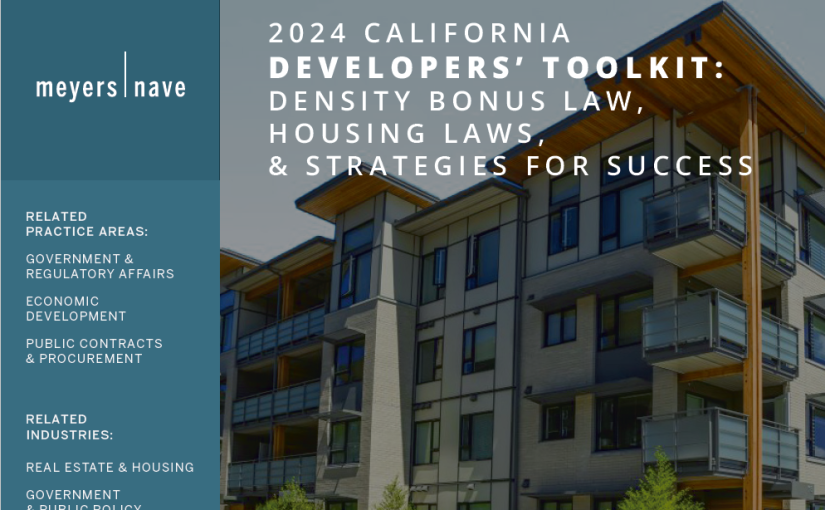
2024 California Developers’ Toolkit: Density Bonus Law, Housing Laws, & Strategies for Success

The California Legislature has continued to refine the Density Bonus Law over the years, making important updates to housing laws that impact developers across the state.

Recent legislative changes include key updates on the Builders Remedy and amendments to AB 2011, as modified by AB 2243 in 2024. These updates reflect ongoing efforts to address California’s housing needs and streamline development processes.

In 2023, the Legislature approved AB 1287, AB 323, and SB 713, further shaping the Density Bonus Law and strengthening other housing laws, such as the Housing Accountability Act and SB 35.

These changes and more are outlined in our 2024 California Developers’ Toolkit (October 2024 update) now available for download.

If you have questions about the Density Bonus Law, Housing Laws, or any of the information provided in this toolkit, please contact the author, Meyers Nave Principal, Russell Morse via email at rmorse@meyersnave.com.

Meyers Nave Secures Appellate Victory for City of San Diego in Utility Relocation Dispute

We are pleased to share a significant appellate victory achieved in partnership with our client, the City of San Diego. The Court of Appeal reversed the lower court in full, granting summary judgment in favor of the City in the dispute with San Diego Gas & Electric Company (SDG&E) over utility relocation costs related to the City’s ambitious Pure Water Project.

Background of the Dispute

The case centered on the costs associated with relocating SDG&E’s gas pipelines and other utility infrastructure to facilitate the City’s ambitious Pure Water Project. This project is the largest and most costly infrastructure initiative ever undertaken by San Diego, with a total estimated cost of over $3 billion. Its goal is to convert sewage into potable water through advanced purification processes, aiming to significantly enhance the city’s water supply and sustainability.

In 2018, the City Council authorized an initial expenditure of $35 million to begin the relocation process, with the expectation that these costs would be covered by SDG&E under the terms of their franchise agreement. However, SDG&E contested this responsibility, leading to a legal dispute. The City argued that state law and the franchise agreement required SDG&E to bear the costs of relocating its infrastructure for public projects like Pure Water.

The lower court initially ruled against the City, placing the financial burden of relocation costs on San Diego taxpayers.

Appellate Court Decision

The appellate court’s decision marks a pivotal victory for the City. The court thoroughly reviewed the franchise agreements and determined that SDG&E is indeed responsible for covering the relocation costs. This ruling reverses the previous judgment and directs the superior court to enter summary judgment in favor of the City. Additionally, the court denied SDG&E’s petition for a rehearing.

This decision not only relieves the City of a significant financial burden but also supports the continued progress of the Pure Water Project without additional taxpayer expense.

Acknowledgments

This outcome highlights the successful collaboration between Meyers Nave and the City of San Diego. Our team, led by David Skinner with the invaluable support of Nicole Ries Fox and Kristof Szoke, is proud to have played a role in securing this favorable result.

We are dedicated to providing exceptional legal representation and are honored to have supported the City in this important matter. The ruling ensures that resources can be allocated more effectively toward vital public infrastructure and sustainability initiatives.

Meyers Nave Celebrates the Successful Approval of the DisneylandForward Initiative

We are thrilled to announce another major accomplishment for the Meyers Nave team! Earlier this week, the Anaheim City Council gave unanimous approval to the DisneylandForward project, marking a significant milestone in our longstanding partnership with the City.

For the past two years, our Land Use & Environmental Law team, Kiana Amiri-Davani, and Mina Arasteh, has played a critical role in ensuring compliance with environmental standards under CEQA and navigating the project’s complex approval process. Our contributions included extensive legal analysis during the environmental review process, preparation of the Supplemental Environmental Impact Report (SEIR), and active participation in key City meetings. We also helped provide clear and accessible information to the public about the project’s environmental impacts.

DisneylandForward is a legacy project that calls for Disney’s commitment to invest a minimum of $1.9 billion over the next 10 years. The project allows for expanding the areas on which theme park attractions are allowed as well as new areas for shopping, dining and entertainment uses. In addition, the project includes community benefits paid by Disney, including $30 million for affordable housing, $8 million for City parks and $45 million for street and sewer improvements, among other benefits.

A big thank you to the City of Anaheim for entrusting us with this important project and to everyone involved in reaching this milestone!

Learn more about DisneylandForward here.

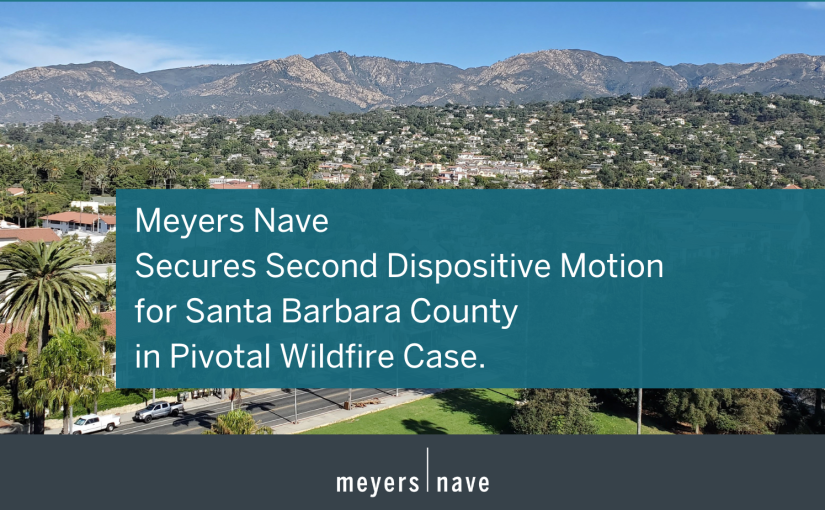
Meyers Nave Secures Second Dispositive Motion for Santa Barbara County in Pivotal Wildfire Case

Meyers Nave is proud to announce another landmark victory, this time in the complex wildfire litigation surrounding the 2017 Thomas Fire and Montecito debris flow. The Thomas fire, sparked by power lines owned by Southern California Edison, burned more than 281,000 acres and was at the time the largest wildfire in recorded California history. The resulting debris flow overwhelmed the town of Montecito, causing more than 20 deaths and hundreds of millions of dollars in damage to homes and businesses. In a subsequent legal maneuver, Edison attempted to recover $1 billion in damages by shifting blame onto the County of Santa Barbara and other public entities.

In response, the County, represented by our skilled Trial & Litigation Team, mounted a robust defense against these substantial indemnity claims. Our legal team’s aptitude was pivotal in eliminating significant damages through a series of strategic dispositive motions, demonstrating our deep understanding of environmental litigation and public entity defense.

Throughout the proceedings, Meyers Nave investigated complex issues involving the interplay of legal standards and the facts at issue. The firm also established comprehensive case and document management systems to effectively navigate the coordinated judicial process.

Our firm’s commitment to delivering excellent legal advice and achieving definitive results for our clients shines through. This victory not only emphasizes our capability to handle high-stakes, complex legal challenges but also our dedication to safeguarding the interests of public entities across California.

Deborah Fox, who leads our Trial and Litigation practice group and the County of Santa Barbara team, commented, “This case highlights the crucial role of skilled legal advocacy in defending public entities against substantial and often unprecedented legal challenges. Our team’s ability to effectively manage and litigate complex environmental and indemnity issues has led to significant outcomes that not only benefit our client but also set a precedent for future wildfire litigation.”

Meyers Nave continues to demonstrate unparalleled capability and dedication, reinforcing why we are the go-to law firm for high-profile legal matters in California.

Learn more about our Trial and Litigation capabilities and how we partner with clients to navigate complex legal landscapes.

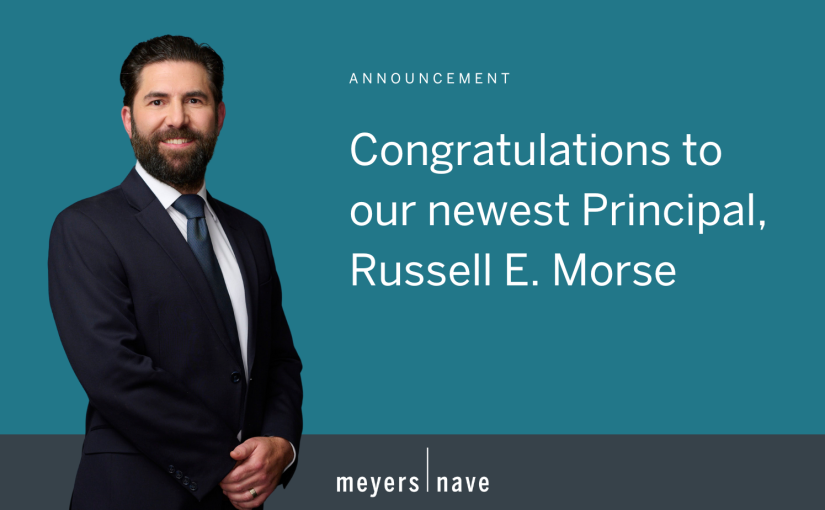
Meyers Nave Elevates Russell E. Morse to Principal

January 3, 2024

Meyers Nave has elevated Senior Of Counsel Attorney Russell E. Morse to Principal of the Firm, effective January 1, 2024.

Managing Principal David Skinner emphasizes that “Russell is a go-to counsel for cutting-edge real estate and land use projects throughout California. His distinctive blend of creativity, experience, and business acumen in addressing complex legal challenges sets him apart and positions him as a genuine business collaborator with our clients. We are fortunate to welcome Russell as a Principal with the Firm, and we look forward to his leadership in the years ahead.”

Russell earned his undergraduate degree from the University of California at Los Angeles (B.A., political science and anthropology) and his J.D. from Loyola Law School, Los Angeles. He is a deeply experienced attorney in real estate transactions and land use, uniquely able to support clients from the property acquisition stage through entitlements and environmental review. His practice focuses on land use and zoning, CEQA, housing development and real estate law. Private developers, hospitality companies and public entities benefit from his experience and skill to complete complex initiatives, including large affordable housing projects and projects using the Housing Accountability Act and Builder’s Remedy. Also recognized for his pro bono work, Russell has helped Native American tribal-affiliated groups with land back transactions, the first of their kind in Orange and Los Angeles Counties.

Russell explains, “Meyers Nave has given me the opportunity to work on the most exciting land use, CEQA and real estate projects in California alongside a team of exceptional attorneys who are also genuinely good people. I am excited to become a Principal and leader with the Firm and support its continued growth.”

California Employer’s Legal Update: Summary of New Laws Effective January 1, 2024

Following our annual Employment Law Update webinars for Private Sector and Non-Profit Employers, and Public Entity Employers, our Labor & Employment Team provides a summary of their 2024 Employment Law Update detailing new and evolving laws for all types of employers.

This 2024 Employment Law Update covers the following new laws effective January 1, 2024:

  • Reproductive Loss Leave for Employees (SB 848)
  • Federal Pregnancy Workers Fairness Act
  • Paid Sick Leave Now At Least 5 Days (SB 616)
  • Minimum Wage
  • Workplace Violence Prevention Program (SB 553)
  • Presumption of Retaliation (SB 497)
  • Increased Minimum Wage for Health Care Workers (SB 525)
  • Fast Food Minimum Wage Increase (AB 1228)
  • Food Handler Cards (SB 476)
  • Ban on Noncompete Agreements & Notice Requirements (SB 699, AB 1076)
  • Arbitration Enforcement (SB 365)
  • Off-Duty Cannabis Use & Drug Test Results (AB 2188 & SB 700)
  • Enforcement of Labor Code Violations (AB 594)

Season’s Greetings from Meyers Nave

(Play/Pause|Volume)

As we reflect upon the year’s achievements and look ahead to a bright new year, we are thankful to serve our incredible clients and to work with our wonderful colleagues. We wish everyone health & happiness this holiday season and all year long!

As a gesture of our appreciation, we are pleased to support the following food banks located throughout California in the communities that we serve and call home:

  • Alameda County Community Food Bank
  • Sacramento Food Bank & Family Services
  • San Diego Food Bank
  • Los Angeles Regional Food Bank

Our attorneys and staff are always available should you need us.

Happy New Year!

Meyers Nave’s Eminent Domain Team Continues its Successful Partnership With LA Metro on the Westside Purple Line Subway Extension Project

Meyers Nave’s Eminent Domain Team is proud to continue its partnership with the Los Angeles County Metropolitan Transportation Authority on its property acquisition needs to extend the Westside Purple Line Subway Extension Project from Downtown Los Angeles to Westwood/UCLA. We successfully concluded another eminent domain jury trial on the value of a subsurface subway tunnel easement located in the City of Beverly Hills — on Wilshire Boulevard, across the street from the “Golden Triangle.” The landowner’s appraiser valued the subsurface easement and alleged severance damages at $25,620,000. LACMTA’s appraiser concluded that the total appraised value was $90,000. The jury verdict was in the sum of $235,000.

This jury trial follows another successful jury verdict for Meyers Nave’s Eminent Domain Team on behalf of LACMTA. In July 2022, our Team partnered with LA Metro to secure a favorable jury verdict for a subsurface subway tunnel easement beneath the Beverly Hills High School. (See article here.) These trial results bolster LA Metro’s ongoing initiatives to reduce traffic, congestion and carbon emissions from automobile use, and to provide affordable public transportation options to all in Los Angeles.

David Skinner was lead counsel in both trials. The Meyers Nave Team also included Associate, Kristof Szoke.

What Public Employers Should Know About Liability for Employee Work-From-Home Expenses

A recent California Court of Appeal case (Krug v. Board of Trustees of the California State University) has implications for public agencies regarding employee reimbursement for work-from-home expenses.

Even though Labor Code Section 2802 does not explicitly or implicitly mention that it applies to government agencies, public employers should know they could still be responsible for an employer’s necessary expenditures to work from home.

This article breaks down the key takeaways and offers guidance.

Key Takeaways:

  • Labor Code Section 2802: This section requires employers to reimburse employees for reasonable and necessary work-related expenses.
  • CSU Case: In August, a California Court of Appeal ruled that California State University (CSU) did not have to reimburse a professor for home-office equipment and supplies acquired during the pandemic. The court cited CSU’s sovereign power granted by the California Education Code, allowing it discretion over purchases and reimbursements.
  • Sovereign Powers Doctrine: Public agencies are generally exempt from Labor Code requirements unless specifically included. The Sovereign Powers Doctrine shields public entities unless their inclusion would infringe on their sovereign powers, often granted by other laws.
  • Three-Part Test: The court applied a three-part test to determine whether the Sovereign Powers Doctrine applied:
    (1) Does the Labor Code provision explicitly mention governmental agencies?
    (2) Is there legislative intent to exempt them?
    (3) Would applying the Labor Code provision infringe on sovereign powers?
  • Krug’s Case: In Krug’s case, Labor Code Section 2802 did not expressly mention governmental agencies, and the legislative intent was silent. However, CSU’s sovereign power over expenses, granted by the Education Code, led to the denial of reimbursement.
  • Potential Liability: This case implies that public agencies might be liable for employee work-from-home expenses if their governing legislation doesn’t explicitly grant discretion for such reimbursements.

Guidance for Public Agencies:

  • Review Governing Legislation: Public agencies should carefully review the legislation that grants them sovereignty. If it does not explicitly address employee work-from-home expenses, they may be at risk for potential liability.
  • Consult Legal Experts: It is advisable for public agencies to consult with experienced attorneys to assess their liability under this new court holding and ensure compliance with labor laws.

In summary, the recent court case has highlighted the potential liability for public agencies in reimbursing employees for work-from-home expenses.

Public agencies should assess their governing legislation and seek legal counsel to navigate this complex issue and determine their obligations under Labor Code Section 2802.